Liu Ye
Introduction
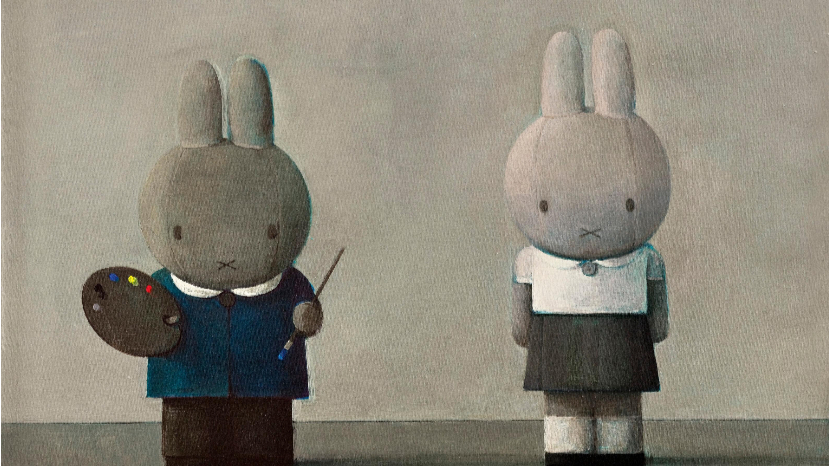
Liu Ye, born in 1964 in Beijing, is a renowned contemporary Chinese artist recognized for his distinctive style that features bright-hued paintings of childlike female figures, as well as his favorite cartoon character, Miffy the bunny. His art is also heavily inspired by the works of Piet Mondrian. Unlike many other Chinese artists of his generation who often delve into political themes, Liu Ye's artworks focus on a universal language that reflects his inner world. His artwork has gained international acclaim and has been exhibited extensively across China, Europe, and the United States, establishing him as a prominent figure in the contemporary art scene.
Early Life
Liu Ye was born and raised in Beijing. As a child, he was exposed to works by Hans Christian Andersen, Alexander Pushkin, Leo Tolstoy, and Chinese classics such as Journey to the West and The Water Margin. These literary treasures not only influenced Liu Ye's upbringing but also left a lasting impression on his artistic endeavors.
From an early age, Liu Ye demonstrated a keen interest and talent in drawing. At the age of 10, he began formal art training under the guidance of Tan Quanshu, who became his first official art teacher. Under Tan's mentorship, Liu honed his basic artistic skills, attending drawing lessons once or twice a week for five years. This formative period was crucial in shaping his foundational techniques in art. However, at the age of 13, Liu Ye temporarily paused his art studies due to a diagnosis of amblyopia in his left eye. Despite concerns that this condition might affect his spatial perception as an artist, Liu Ye remained steadfast in his resolve to pursue a career in art, and his condition did not hinder his artistic expression.
Education
In 1980, Liu Ye applied to the Interior Design department at the School of Arts & Crafts in Beijing. However, he ultimately enrolled in the Industrial Design department, where he was introduced to Western modern art for the first time. This exposure included the teachings of the Bauhaus movement and the works of Piet Mondrian, who would later become a significant influence on his art. After completing his studies at the School of Arts & Crafts in 1984, Liu Ye worked at the Beijing Gongmei (arts and crafts) Group's research center while simultaneously preparing for college entrance exams.
In 1986, Liu Ye enrolled in the Mural Painting department at the Central Academy of Fine Arts, where he excelled academically. During this period, Chinese college students developed a growing enthusiasm for psychology and philosophy, particularly the works of Sigmund Freud, Friedrich Nietzsche, and Hendrik van Loon. Liu Ye found inspiration in these intellectual pursuits and often drew comic strips for newspapers to earn some income. In 1989, before graduating from the Central Academy of Fine Arts, Liu Ye traveled to Germany, where he passed the entry exam for the Berlin University of the Arts. He completed his undergraduate studies there, receiving his MFA in 1994. His time in Europe allowed him to further immerse himself in diverse artistic influences, broadening his creative horizons.
In 1998, Liu Ye participated in an artist-in-residence program at the Rijksakademie in Amsterdam, where he continued to refine his skills and artistic vision. In 2001, he undertook an internship at the Delfina Studio Trust in London, further enriching his artistic development.
Artistic Career
Liu Ye's artistic career is characterized by a meditative exploration of history and representation, employing a unique visual language that transcends time and place. His paintings evoke both conceptual and emotional registers of meaning, drawing on his childhood memories and early education in Europe. Liu Ye meticulously balances and renders his works, drawing from a wide range of aesthetic and cultural sources.
Influences and Style
Liu Ye's art is deeply influenced by his childhood experiences and exposure to Western art and literature. The clandestine collection of banned literature maintained by his father played a pivotal role in shaping his artistic perspective. The works of Hans Christian Andersen, Alexander Pushkin, and other literary giants left an indelible mark on his imagination. Furthermore, his formal education introduced him to the teachings of the Bauhaus and the works of Piet Mondrian, whose emphasis on geometric abstraction resonated with Liu Ye's artistic sensibilities.
Liu Ye's style is characterized by vibrant, bright colors and childlike female figures, often accompanied by Miffy the bunny, a beloved cartoon character. His paintings offer a sense of innocence and whimsy, while also conveying deeper emotional and conceptual themes. Liu Ye's work emphasizes a universal language, allowing viewers to connect with his art on multiple levels.
Major Works
Liu Ye's oeuvre includes a diverse array of paintings that showcase his distinctive style and artistic influences. His major works often feature recurring motifs such as childlike figures, cartoon characters, and references to Western art movements. His paintings are celebrated for their meticulous attention to detail, harmonious compositions, and the ability to convey complex emotions through seemingly simple imagery.
Exhibitions
Liu Ye's work has been exhibited extensively in solo and group exhibitions worldwide. His first exhibition with David Zwirner, "Liu Ye: The Book and the Flower," was held in 2020 at the gallery's East 69th Street location in New York. In 2023, his artwork was showcased at David Zwirner in London in a solo presentation titled "Liu Ye: Naive and Sentimental Painting." In 2018, "Liu Ye: Storytelling" opened at Prada Rong Zhai in Shanghai and later traveled to the Fondazione Prada in Milan, where it was on view in 2020.
Other notable solo museum presentations include exhibitions at Mondriaanhuis in Amersfoort, the Netherlands (2016), and Kunstmuseum Bern in Switzerland (2007). Liu Ye's art has also been featured in significant international group exhibitions, including the 57th Venice Biennale in 2017, where his work was part of "Viva Arte Viva," curated by Christine Macel, director of the biennale and chief curator at the Centre Pompidou, Paris.
Recognition and Awards
Liu Ye's contributions to the world of contemporary art have earned him widespread recognition and accolades. His work is held in numerous public collections, including prestigious institutions such as the Long Museum in Shanghai, the M+ Sigg Collection in Hong Kong, the Museum of Art Pudong in Shanghai, the Shanghai Art Museum, Today Art Museum in Beijing, and the Yuz Museum in Shanghai. Liu Ye continues to live and work in Beijing, where he continues to create art that transcends cultural boundaries and resonates with audiences worldwide.








